Wednesday, March 17, 2021

Michael Gaeta and FBI Counterintelligence -- Part 10

Part 1, Part 2, Part 3, Part 4, Part 5, Part 6, Part 7, Part 8, Part 9

=======

In Part 9, I speculated that computer viruses were placed onto the DNC's computer server not by Russian Intelligence, but rather by American computer experts who supported Bernie Sanders. Part 9 began as follows:

In 2015 and 2016, a company called NGP VAN provided the software that controlled the voter database of the Democrat National Committee (DNC). On the morning of December 16, 2015, NGP VAN launched a modification of that software.

On that same morning, Josh Uretsky, a member of Sanders' campaign staff, exploited a bug in the modification and thus accessed some database files that belonged to Hillary Clinton's campaign staff. Uretsky instructed three fellow members of Sanders' campaign staff how to exploit the bug. Then those four Sanders staff members accessed and downloaded data from Clinton's database files for about 45 minutes. Within about four hours of the modification's launch, the improper exploitation of the bug was discovered and stopped.

That incident was followed by a sequence of actions:

* The DNC restricted the Sanders campaign staff's use of the DNC server on December 17, 2015.

* The Sanders campaign staff filed a lawsuit against the DNC on December 18, 2015.

* The Sanders campaign staff served the lawsuit to the DNC on March 24, 2016.

* The DNC was allowed to initiate legal discovery processes against the Sanders campaign staff.

* The DNC terminated its lawsuit on April 29, 2016.

In regard to that sequence, I speculated:

For some Sanders-supporters, the fact that the DNC now was examining and searching the Sanders campaign staff's files aggravated resentments that the DNC was treating Sanders unfairly. In contrast, Clinton's campaign staff was not being examined and searched.

During the discovery process, the political circumstances were that from March 22 through April 9, 2016, the DNC conducted eight primary elections, and Sanders won seven of the eight elections. Specifically, Sanders won in Idaho, Utah, Alaska, Hawaii, Washington, Wisconsin and Wyoming -- and lost only in Arizona. Sanders' supporters felt that Sanders' campaign might be on the verge of passing Clinton decisively in the primary election race.

Perhaps a Sanders-supporter with the necessary computer skills decided that the time was ripe to discover information inside the Clinton campaign staff.

If such a Sanders-supporter indeed did decide to discover such information, then a key action occurred on March 19, 2016, when there was a successful phishing of the e-mail account of John Podesta, the chairman of Hillary Clinton's campaign staff. That phishing occurred five days before the Sanders campaign staff served the lawsuit to the DNC on March 24 -- the last legal day to serve the lawsuit.

=======

Let's imagine the perspective of the hypothetical Sanders-supporter computer expert on March 16, 2016. On the previous day, March 15, Clinton had defeated Sanders in five primary elections -- in Florida, Illinois, Missouri, North Carolina and Ohio. However, in the following days (through April 9) Sanders was favored to win (and did win) primary elections in seven states -- Idaho, Utah, Alaska, Hawaii, Washington, Wisconsin and Wyoming. Sanders still had a real chance to defeat Clinton in the primary race.

In such circumstances, however, the Sanders campaign staff had to serve its lawsuit on the DNC no later than March 24. Beginning on that day, the DNC would be able to initiate a legal discovery procedure against the Sanders campaign staff. If the DNC did discover any information discrediting or incriminating the Sanders campaign staff, then the DNC surely would share such information immediately with the Clinton campaign staff. In such circumstances, the Sanders-supporter computer expert felt morally justified in initiating his own secret "discovery procedure" against the DNC and against the Clinton campaign staff. One of the first actions in this secret "discovery procedure" was the phishing of Podesta on March 19.

Another eventual action in this secret "discovery procedure" was to place computer viruses onto the DNC server in order to collect information about the DNC. I speculate that the Sanders-supporter computer expert did so between April 15 and May 2 2016. (I will explain those two dates below.)

I speculate further that he used computer viruses that apparently had been developed by Russian Intelligence. As I told in my Part 9, the CIA had collected a so-called "arsenal" of foreign computer viruses but had lost its exclusive control of this arsenal. Therefore computer viruses developed by Russian Intelligence were available to the Sanders-supporter computer expert, who put them onto the DNC computer in late March 2016 during his own secret "discovery procedure".

Later, those computer viruses were found by CrowdStrike, and that finding eventually enabled the FBI to argue falsely that Russian Intelligence was meddling in the US elections in 2016.

======

CrowdStrike investigated the DNC computer system twice.

1) CrowdStrike investigated that system in regard to the Uretsky affair. This investigation took place sometime between December 16, 2015 and April 29, 2016.

2) CrowdStrike investigated that system in regard to the FBI's suspicion that Russian Intelligence had infiltrated the system. This investigation too place between May 2 and June 14, 2016.

The second CrowdStrike investigation began as follows.

On the late afternoon of Friday, April 29, 2016 -- the very same day when the Sanders campaign staff terminated its lawsuit that had been caused by a Sanders supporter's hack of the DNC's computers -- an unidentified FBI official conducted a conference call with two people:

1) an unidentified DNC staff member who managed the DNC computer system

2) Michael Sussman, a computer-security expert employed by the Perkins Coie law firm, which provided legal services to the DNC.

The FBI official discussed with them the FBI's suspicion that Russian Intelligence was hacking into the DNC computer system.

During the following weekend, April 30-May 1, Sussman called Shawn Henry, a CrowdStrike manager. Sussman arranged with Henry that CrowdStrike would study the alleged Russian Intelligence hack of DNC computers. Thus, the second investigation began on May 2.

I speculate that the first investigation ended by April 15. I say so because that FBI official contacted the DNC computer manager in about the third week of April 2016 (i.e. April 17-23) to request the DNC's computer server logs. I speculate that the FBI's request was prompted at least partially by the conclusion of CrowdStrike's first investigation.

Since CrowdStrike apparently did not find any allegedly Russian-Intelligence computer viruses on the DNC system during the first investigation, the computer viruses were placed on the DNC system during the interval between April 15 and May 2, 2016.

(Keep in mind that I can only guess that the first CrowdStrike investigation ended on April 15, 2016. If the actual date ever is revealed, then I will be able to correct the interval.)

========

CrowdStrike's second investigation ended by June 14, 2016, since on that day The Washington Post published an article about that investigation's findings. Essentially, the second investigation found computer viruses that were attributed to Russian Intelligence.

However, I am suggesting in my article here that those viruses actually were placed on the DNC computer system by a Sanders-supporter computer expert who was conducting his own "discovery procedure" against Hillary Clinton's campaign. Furthermore, I am suggesting that that computer expert did so sometime between April 15 and May 2, 2016.

The Washington Post article that was published on June 14 would have informed the Sanders-supporter computer expert that CrowdStrike had found the computer viruses that he had placed onto the DNC system. However, if that computer expert was an "insider" -- if he worked, for example, at DNC or in the Sanders campaign or at NGP VAN -- then he might have been informed a couple days before June 14. (As you will see below, something significant happened on June 12.)

In any case, the computer expert had to deal with the possibility that further investigation might find the actual truth -- that the computer viruses had been placed on the DNC not by Russian Intelligence, but rather by the Sanders-supporter computer expert.

Let's suppose that the computer expert worked at the DNC or at NGP VAN and that his normal access to the DNC system enabled him to simply infiltrate the viruses directly onto the DNC system. In other words, the viruses were not "hacked" onto DNC by phishing or some other such trick.

Let's suppose further that CrowdStrike did find the computer viruses on the DNC system but could not figure out for sure how the viruses infiltrated onto the system. Until CrowdStrike did figure out that mystery, the Sanders-supporter computer expert had to worry that CrowdStrike eventually might figure out the actual culprit and infiltration method.

Therefore, the Sanders-supporter computer expert had to provide to CrowdStrike a plausible explanation of how the computer viruses were infiltrated onto the DNC by means of a hacking trick. Because of his computer expertise and because of his actual experience in working with the DNC computer system, he indeed was able to provide such plausible explanation. To commuicate that plausible explanation to CrowdStrike, the Sanders-supporter computer expert created the fictional character Guccifer 2.0.

=======

The actual person who pretended to be Guccifer 2.0 pretended to be a Romanian hacker. The actual person spoke native English but apparently spoke also Romanian, but not with native skill. (Or he at least was helped by some such Romanian speaker.) Pretending to speak Russian would have made more sense in this situation, but the actual person apparently did not speak Russian adequately.

On June 21, 2016, the character Guccifer 2.0 (i.e. the Sanders-supporter computer expert) arranged to be interviewed, by means of e-mail, by a journalist named Lorenzo Franceschi-Bicchierai. In that interview, Guccifer provided a plausible explanation of how the DNC computer system was hacked.

Why else would this supposed hacker reveal his hacking method to a journalist?

The below interview transcript was published by Yaacov Apelbaum in his superb blog article Who Done It?. There, the journalist is called "Motherboard". I have added the emphasis to the transcript.

========

[Motherboard:] So, first of all, what can you tell me about yourself? Who are you?

[Guccifer 2.0:] i’m a hacker, manager, philosopher, women lover. I also like Gucci! I bring the light to people. I’m a freedom fighter! So u can choose what u like!

[Motherboard:] And where are you from?

[Guccifer 2.0:] From Romania.

[Motherboard:] Do you work with Russia or the Russian government?

[Guccifer 2.0:] No because I don’t like Russians and their foreign policy. I hate being attributed to Russia.

[Motherboard:] Why?

[Guccifer 2.0:] I’ve already told! Also I made a big deal, why you glorify them?

[Motherboard:] Tell me about the DNC hack. How did you get in?

[Guccifer 2.0:] I hacked that server through the NGP VAN soft, if u understand what I’m talking about.

[Motherboard:] So that was your entry point, what happened next?

[Guccifer 2.0:] I used 0-day exploit of NGP VAN soft then I installed shell-code into the DNC server. it allowed me to intrude into DNC network. They have Windows-based domain architecture. then I installed my Trojans on several PCs. I had to go from one PC to another every week so Crowdstrike couldn’t catch me for a long time. I know that they have cool intrusion detection system. But my heuristic algorithms are better.

[Motherboard:] When did you first hack them?

[Guccifer 2.0:] Last summer.

[Motherboard:] And when did you get kicked out?

[Guccifer 2.0:] June 12, when they rebooted their system.

[Motherboard:] And why did you hack the DNC in the first place?

[Guccifer 2.0:] DNC isn’t my first deal.

[Motherboard:] Who else have you hacked?

[Guccifer 2.0:] Follow my blog and u’ll know! I can’t tell u now about all my deals. My safety depends on it.

[Motherboard:] OK, I understand. But why did u target DNC? why are you interested in them?

[Guccifer 2.0:] Lazar began this deal and I follow him! I think we must fight for freedom of minds, fight for the world without Illuminati

[Motherboard:] Lazar?

[Guccifer 2.0:] Marcel Lazăr [The original Gufficer]

[Motherboard:] Ah yeah of course. Did you know him personally?

[Guccifer 2.0:] I can’t answer cause I care for Marcel.

[Motherboard:] Ai vrea să vorbească în română pentru un pic? [You want to talk for a bit in Romanian?]

[Guccifer 2.0:] Vorbiți limbă română? [Speak Romanian?]

[Motherboard:] Putin. Poți să-mi spui despre hack în română? cum ai făcut-o? [A little. Can you tell me about hack in Romanian? How did you do it?]

[Motherboard:] Or u just use Google translate?

[Motherboard:] Poți să răspunzi la întrebarea mea? [Can you answer my question?]

Guccifer 2.0: V-am spus deja. încercați să-mi verifica? [I have already said. try to check?]

Guccifer 2.0: Da [Yes]

Guccifer 2.0: Nu vreau să-mi pierd timpul [I do not want to waste my time]

[Motherboard:] De ce ai pus metadate rusă în primul lot de documente? [Why did you put Russian metadata in the first batch of documents?]

Guccifer 2.0: Este filigranul meu [It is my watermark]

[Motherboard:] De ce nu l-ai pus pe documentele de azi? [Why didn’t you put it in the documents today?]

Guccifer 2.0: Puteți găsi de asemenea alte filigrane în limbă spaniolă. Caută mai bine. [You can also find other watermarks in Spanish. Look better]

[Motherboard:] Sunt confuz de ceea ce spui, filigran, pentru că este mereu în schimbare. Pot să vă rog să-mi explicați în propria ta limba maternă? Așa că este mult mai clar. [I’m confused by what you say, why is watermark changing? Can you please explain to me in your own language? So it is more clear.]

[Guccifer 2.0:] Oare nu știți ce este filigran? [You do not know what watermark?]

[Motherboard:] Eu fac. Dar eu nu înțeleg de ce ai folosit filigrane rusești în unele Docs și nu în altele [I do. But I do not understand why you use watermarks in Russian in some documents and not in others?]

[Guccifer 2.0:] îți voi arăta [I will show you]

[Motherboard:] Please do.

[Motherboard:] De ce faci toate astea? [Why are you doing this?]

[Guccifer 2.0:] Asta e din partea următoare [That’s the next]

[Motherboard:] What?

[Guccifer 2.0:] Am spus deja, e un filigran, un semn special [I have already said, it’s a watermark, a special sign]

[Motherboard:] Do you like Trump?

[Guccifer 2.0:] I don’t care at all

[Motherboard:] кто-то говорит мне, что ты румынская полна ошибок [Someone tells me that your Romanian is full of mistakes.]

[Guccifer 2.0:] What’s this? Is it russian?

[Motherboard:] You don’t understand it?

[Guccifer 2.0:] R u kidding? Just a moment I’ll look in google translate what u meant. “Someone tells me that you are full of mistakes Romanian.”

[Motherboard:] Hai sa-ti pun cateva intrebari, ca sa vad ca esti cu adevarat roman [Let me ask you a few questions to see that you are truly native.]

[Guccifer 2.0:] Man, I’m not a pupil at school.

[Motherboard:] What do you mean?

[Guccifer 2.0:] If u have serious questions u can ask. Don’t waste my time.

[Guccifer 2.0:] Am mult de făcut [I have much to do]

[Motherboard:] Si cat umblai prin reteaua astora de la DNC, mai hackuise si altcineva in afara de tine [When you got into the DNC network was someone else there besides you?]

[No answer]

=======

Continued in Part 11

Thursday, January 28, 2021

Will Brad Raffensperger ever explain the water incident?

This article elaborates my preceding three articles:

1) How long did the imaginary burst waterpipe delay the ballot-counting?,

2) The Scanners' Long, Covered Table.

3) The Target Dot on the Scanners' Long, Covered Table

=======

On December 4, 2020, President Donald Trump submitted to the Superior Court of Fulton County, Georgia, a civil action titled Verified Petition to Contest Georgia's Presidential Election Results for Violations of the Constitution and Laws of the State of Georgia. The primary respondent is Brad Raffensperger, Georgia's Secretary of State.

The Petition complains that "There were systemic irregularities and violations of the Georgia election code in the contested election" (page 16).

In particular, "Respondents have admitted misconduct, fraud, and widespread irregularities committed by multiple counties" (page 41).

In particular (pages 42-44):

186.

The Secretary of State’s [i.e. Raffensperger's] Office claims it is currently investigating an incident where Fulton County election officials fraudulently stated there was a "flood" and "a pipe burst," which was later revealed to be a "leaky' toilet.

187.

At approximately 10:00 p.m. on November 3, 2020, Fulton County Election Officials, who were handling and scanning thousands of ballots at the State Farm Arena, instructed Republican poll watchers and the press that they were finished working for the day and that the Republican poll watchers and the press were to leave. The Fulton County Elections Officials further stated that they would restart their work at approximately 8:00 a.m. on November 4, 2020.

188.

The Fulton County Election Officials lied.

189.

Deliberate misinformation was used to instruct Republican poll watchers and members of the press to leave the premises for the night at approximately 10:00 p.m. on November 3, 2020. Exhibits 12, 13, and 14 attached hereto and incorporated by reference.

190.

After Fulton County Elections Officials lied and defrauded the Republican poll watchers and members of the press, whereby in reasonable reliance the Republican poll watchers and members of the press left the State Farm Arena (where they had been observing the ballots being processed), without public transparency Fulton County Elections Officials continued to process, handle, and transfer many thousands of ballots. See Exhibit 14

191.

Fulton County Elections Officials’ fraudulent statements not only defrauded the Republican poll watchers and the press, but also deprived every single Fulton County voter, Georgian, American, and Petitioners of the opportunity for a transparent election process and have thereby placed the Election Contest in doubt.

On January 2, 2021, the Petition was discussed in a phone conversation that included Trump and Raffensperger. That conversation has been analyzed by an anonymous lawyer, alias "Shipwreckedcrew", in an article titled The President's Call With the Georgia Sec. of State -- a Case Study in the Media Duplicity That Pres. Trump Has Battled From Day One, published on the Red State website. That article's relevant passages:

The President spent a lot of time in his comments talking about the videotaped events in the counting room of the State Farm Arena in Fulton County. The President repeated many of the claims that have been made by his supporters about the Observers being ordered to leave the room when they were told the counting was be stopped for the night. He raised the issue of the ballots being kept in boxes under the table, only to be brought out and run through the counting machines after the Observers were gone. He made several references to the names of the Democrat party operative who has been the subject of much speculation, particularly with regard to what appears to be her running the same set of ballots through the counting machine more than one time.

In response, Raffensperger claimed that the video that was put out on the internet has been edited, but didn’t specify how. He claimed that investigators from his office as well as the Georgia Bureau of Investigation interviewed everyone in the room, and studied the videotape themselves. They have concluded that nothing evidencing fraud is shown in the videotape, and none of the individuals interviewed provided any information of anything suspicious.

The President’s attorney Cleta Mitchell spoke up again. She asked why Raffensperger’s Office won’t make the reports of that investigation available to the campaign? She said she has asked to see them, but the response of the State has only been words to the effect of “We’ve looked into it and we’re satisfied nothing took place to impact the accuracy of the vote count.” Mitchell asked why the State is insisting that the Campaign simply take their word for it rather than share the results of the investigation that supposedly proves nothing happened. ...

I [Shipwreckedcrew] came away from listening to the call thinking that Raffensperger had been warned ahead of time to not saying anything too specific on any particular claim. They seemed content to just let Pres. Trump talk himself out and say little of substance in response other than they had looked at the claims and found nothing suggesting fraud or invalid voting in the quantity claimed by the complaint. ...

I have been informed that the Petition has been dismissed, but without prejudice. Meanwhile, Raffensperger has agreed to provide real evidence to Trump's lawyers, who will be able to examine that evidence and then re-submit an amended Petition. 

I doubt that Raffensperger ever will explain the flowing-water incident satisfactorily. After all, the incident was a fiction that was concocted to justify two to four hours of unobserved vote-counting in the middle of the night. However, Raffensperger still is not entirely free from a potential deposition about the incident.

Thursday, December 10, 2020

The Target Dot on the Scanners' Long, Covered Table

This article elaborates my preceding articles, How long did the imaginary burst waterpipe delay the ballot-counting? and The Scanners' Long, Covered Table.

This new articles' analysis uses Poliitikot's YouTube video titled NEW VIDEO EVIDENCE! - Georgia election hearing II part 1.


You can enlarge the below screen-shots by clicking on them.

=======

If you go to 26:45 on the YouTube video, you will see the situation at 08:21 a.m. on the morning of Election Day, November 3. Watch the upper-right quadrant.

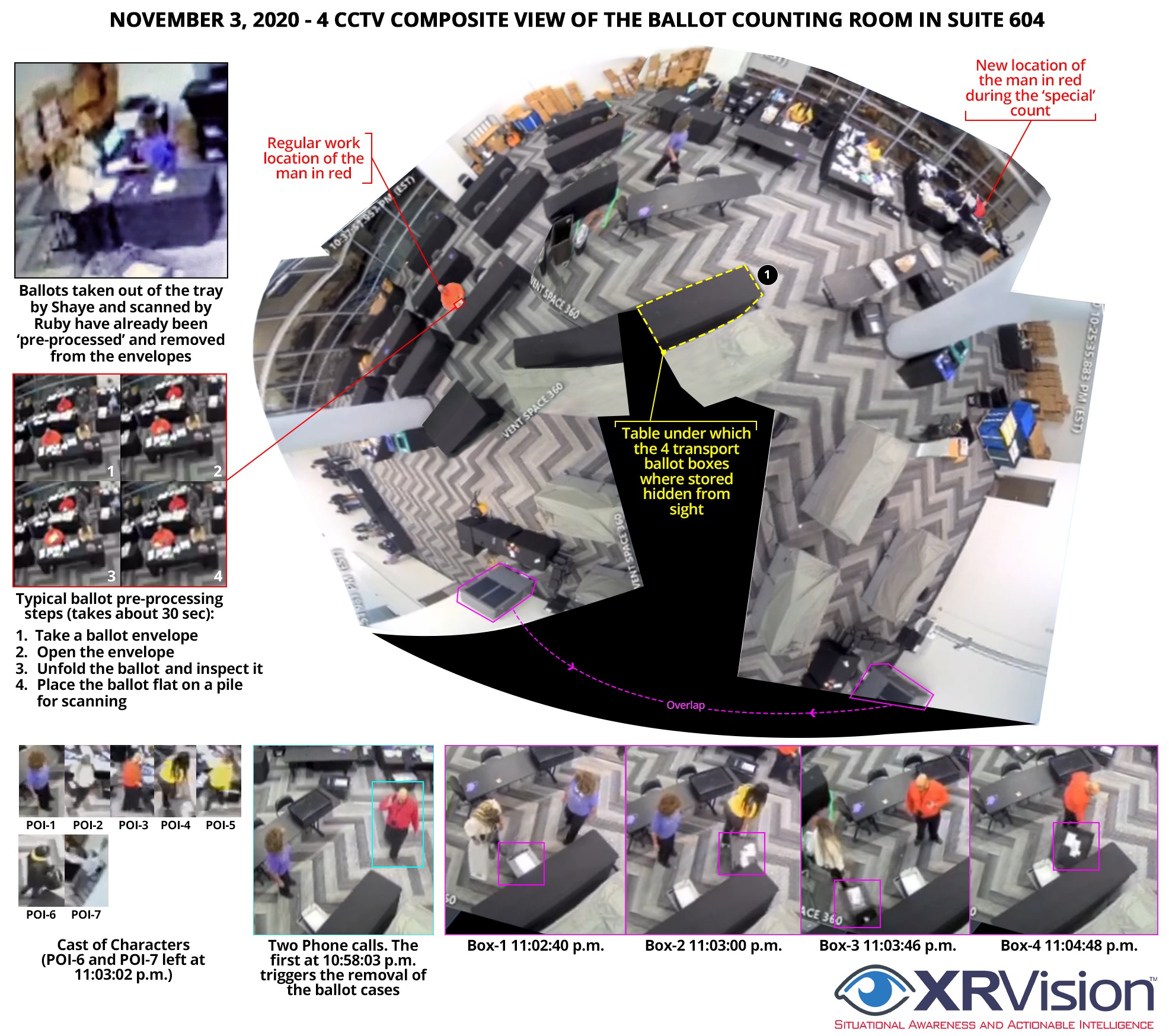
Shaye Moss, the Black woman with blonde braids, pulls a long, black table from the quadrant's lower-left corner and then pushes the table into a special place. She pushes from one end of the table. At the opposite end from Moss is a round, white dot. In the middle of the white dot is a black crosshairs.


Moss pushes the end of her table to the end of another long table. The two tables are placed end-to-end, essentially forming one doubly-long, aligned table. The white dot is only on Moss's table, but the dot can be seen simultaneously in the upper-two quadrants at 27:09 of the video (at 08:22 a.m. on November 3).

The two tables can be seen in a composite image made by Yaacov Apelbaum.


I speculate that the dot was affixed onto the table in order to place the table in optimal view of the camera. The dot was supposed to be above a particular spot on the floor and to be visible at the lower edge of the video's upper-right quadrant. .  


The table was supposed to be the most easily observed object in the entire video. If any questions ever arose about the scanners' unobserved work late on Election Night, then their work could be observed afterwards on the video. The workers would clearly be seen putting their un-scanned ballots under the table at 10:30. Then the workers would be seen taking the ballots back out from under the table at 11 p.m. in order to scan them in the middle of the night. 

Watching the video would debunk suspicions that the workers put any fraudulent ballots into the process. 

======

I speculate that the deception included the following key elements:

* Between 6 and 8 a.m., an imaginary flowing-water incident was concocted.

* Shortly before 8:30, the two long tables -- especially the scanners' table -- were placed so that they were prominently visible in the cameras' views.   

* Sometime during the morning or day, the camera was turned off for one minute, while four boxes of fraudulent ballots were placed under the table.

* In the early evening, journalists were told that the morning's flowing-water incident had delayed the vote-counting by at least two hours. 

* At 10 p.m. everyone was told that counting would be suspended from 10:30 p.m. until 8:30 a.m. 

* A few minutes before 10:30, the scanners packed up their un-scanned ballots into four boxes and put the boxes under their table. 

* While everyone else left right after 10:30 p.m., the scanners loitered until 11 p.m.

* At 11 p.m. the scanners went to their table and pulled the four boxes of fraudulent boxes from under the table. 

* The scanners scanned the four boxes of fraudulent boxes until 1 a.m. 

* Shortly before 1 a.m., the scanners were warned that Republican observers were coming back to the room. The scanners quickly put everything away and departed a few minutes before the observers arrived.   

* During the following few days, the scanners gradually scanned all the ballots in the four boxes that remained under the table. 

If the entire video is watched now, the one minute when the four boxes of fraudulent ballots were placed under the table will not be noticed. The video will have to be examined to find the short interruption in the recording.

=======

Wednesday, December 9, 2020

The Scanners' Long, Covered Table

This article elaborates my preceding article, How long did the imaginary burst waterpipe delay the ballot-counting?

This new articles' analysis uses Poliitikot's YouTube video titled NEW VIDEO EVIDENCE! - Georgia election hearing II part 1.


You can enlarge the below screen-shots by clicking on them.

=======

If you go to 27:09 on the YouTube video, you will see the situation at 08:22 a.m. on the morning of Election Day, November 3. After the below image of all four quadrants, we will look only at the two upper quadrants.


At the bottom of each of the upper quadrants is a long table covered by a black tablecloth. The table in the right quadrant has a white dot, which can be seen also in the left quadrant. If you orient yourself on that white dot, you will recognize that the two long tables are placed end-to-end.


I think that the workers in the left quadrant open the envelopes and removed the ballots. Those workers use the long table in the left quadrant.

The workers in the right quadrant run the ballots through scanning machines. Those workers use the long table in the right quadrant.

=======

If you go to 11:39 in the YouTube video, you will see the situation at 11:02 a.m. on November 3.


This situation is not remarkable. I show it only so that you understand the two upper quadrants.

The left quadrant shows workers opening envelopes and removing ballots. Their table holds three trays of ballots.

The right quadrant shows workers running ballots through scanners. Their table holds one tray of ballots.

Trays of Ballots

Now you can forget about this situation at 11:02 a.m. We will jump forward eleven hours. 

======

If you watch the YouTube video from 13:30 to 16:00, you will see the situation from 9:56 to 10:25 p.m. on November 3. All the workers have been told to stop at 10:30 and to resume working at 8:30 a.m. Focus on the upper-right quadrant, where the scanning workers put ballot trays into black boxes, which they then begin put under their long table.


Unfortunately, the video then skips to 10:37, so we do not see about 12 minutes, when the boxes are placed underneath the table. 

======

Now if you advance the YouTube video to 19:50, you will see the scanning workers begin to remove boxes from under the table at 11:02 p.m.

=======

I wonder whether the boxes that were placed under the table before 10:30 were the same boxes that were removed from under the table after 11 p.m.

The video's narrator says that she counted four boxes removed from under the table after 11:00 p.m. Many more than four boxes can fit under that table.

I speculate that four boxes of fraudulent ballots were brought into the room and placed under during the table during the day. Then after 11 p.m. those wrong four boxes -- not the correct four boxes -- were removed from under the table and scanned.

I can only speculate, because the entire video is not available to the public.

* I would like to watch the table during the entire day, to confirm that no boxes were placed under the table before 10:30 p.m.

* I would like to watch the table after 10:30 p.m., to confirm that all the boxes were placed and removed at precisely the same locations of the table.

If four boxes of fraudulent ballots were placed under the table sometime before 10:30 p.m., then the correct four boxes remained under the table from 10:30 until 1:00 a.m. What happened to the correct four boxes? I speculate that all the ballots in those four correct eventually were scanned too.

The plan was to work four hours and scan all eight boxes. Since the Republican observers came back at 1 a.m., though, only the four boxes of fraudulent boxes could be scanned that night.

in other words, no ballots were removed from the process, but four boxes of fraudulent boxes were added to the process.

======

Continued:

Tuesday, December 8, 2020

How long did the imaginary burst waterpipe delay the ballot-counting?

Journalist Ben Brasch tweeted on Election Day, Tuesday, November 3, at 7:06 p.m., that processing of absentee ballots at State Farm Arena in Atlanta, Georgia, was delayed by four hours because a waterpipe had burst in a room.

In contrast, the 11 Alive news company reported that the the processing was delayed by two hours. This report originally was dated November 3 at 8:26 p.m., but the report was updated on Wednesday, November 4 at 10:27 a.m.

If we assume that 11 Alive said two hours consistently in its original and updated articles, then Brasch was told at about 7:06 p.m. that the delay was four hours, but an 11 Alive journalist was told at about 8:26 p.m. that the delay was two hours.

The supposed pipe-burst had happened at about 6 a.m. and had been fixed by 8 a.m. -- roughly 12 hours before the two journalists were told these quite different estimates of the delay-time.

I speculate that the 11 Alive article originally, on Tuesday evening,  said that the delay was four hours. Then the article was updated on Wednesday morning to say that the estimated delay was two hours. (I am sure that someone can find out what the original article said, but I myself do not know how to do it.)

I speculate that the original plan was to count ballots for four hours during the middle of the night -- from 11 p.m. until 3 a.m.. Then. if that late counting ever were questioned, the explanation would be that a burst waterpipe had delayed the counting by four hours. Therefore, some ballot-counters had to work from from 11 p.m. until 3 a.m. The explanation would be supported by the journalists' reports that had been planted on the evening of Tuesday November 3.

As it turned out, however, some Republican observers who had left at 10:30 p.m. on Tuesday had decided to return to the counting location after midnight. At about 1 a.m., they arrived back at the location, where they learned that the vote-counters had departed just a few minutes earlier.

Because the Republican observers arrived at about 1 a.m., the late-night vote counting did not last four hours, after all. Rather, the late-night counting lasted only two hours.

Of course, the Republican observers were watched constantly after they left at 10:30 p.m. As soon as the Republican observers decided to return to the counting location, the late-night counters were warned to get out quickly. 

In order to fix the story that had been planted to the 11 Alive journalist, he was advised on Wednesday morning to update his article by replacing the expression four hours with the expression two hours.

=======

What does a delay of a few (e.g. two or four) hours mean? For example, the 11 Alive article includes the following two sentences:

Fulton County election officials said they are behind - possibly by about two hours - counting absentee ballots after a pipe burst near a room at State Farm Arena where some of those ballots were being held.

The remaining ballots would be counted by Friday or Saturday [November 6 or 7], though most could be done by Wednesday [November 5].

On Tuesday evening, it is absurd to say that there is a two-hour or four-hour delay in a project that might be finished on Friday or Saturday. The real delay is three or four DAYS -- from Tuesday until Friday or Saturday.

Why say absurdly on Tuesday evening that there is a two-hour or a four-hour delay? The only reason for saying so is to justify an intention to work two hours or four hours in the middle of the night, Tuesday-Wednesday.

======

On Thursday, November 5, Frances Watson, the Chief Investigator of the Georgia Secretary of State, signed a so-called Declaration of Frances Watson. Her Declaration includes the following sentences:

On November 3, 2020, the Secretary of State's Office received complaints that staff of the Fulton County Board of Registrations and Elections directed clerks, public observers and media personnel to leave the State Farm Arena location where ballots were being tabulated due to a water leak at the State Farm Arena, but Fulton County staff continued to scan ballots at the State Farm Arena.

The Secretary of State's Office opened an investigation into the incident at the Sate Farm Arena. Our investigation revealed that the incident initially reported as a water leak in the evening on November 3rd was actually a urinal that had overflowed in the morning of November 3rd, and did not affect the counting of votes later in the evening.

Watson addressed her Declaration to a US District Court in a civil action, but several of her statements seem to be false. For example, she writes that her office received the relevant complaints on Election Day, November 3. Those complaints said that public observers were told on November 3 to leave the ballot-counting location due to a water leak. Watson does not identify any such complainants.  

The actual complaint was made on the morning of Wednesday, November 4. Republican observers complained that they had returned to the State Farm Arena location after 1 a.m. on Wednesday, November 4 and had learned that vote-counters had departed just a few minutes earlier. 

The Republican observers did not complain that they had been told to leave due to a water leak. Rather, they complained that they had been told falsely that all the vote-counting was suspended at 10:30 p.m. on Tuesday evening until 8:30 on Wednesday morning. 

Watson misinformed the US District Court about the day when she received the complaint and about the essence of the complaint.

What did Watson want the US District Court to misunderstand?

The US District Court was misled by Watson to think wrongly that the Republican observers returned to the State Farm Arena location before midnight, still on November 3. Then, the Republican observers complained that they had been told to leave at 10:30 because of a water leak. The US District Court was supposed to think that the Republican observers were confused about some water leak.

Watson did not want the US District Court to understand that, in fact, the Republican observers returned to the State Farm Arena location at 1 a.m. on Wednesday, November 4, and then learned that vote-counting had continued until almost 1 a.m. The Republican observers subsequently complained to Watson's Office during office hours on Wednesday morning. Their complaint was about the unobserved vote-counting in the middle of the night.

======

In general, Watson's reporting and evaluation of events seem to be deceptive. The US District Court and the public should exercise the utmost skepticism when considering any of her statements. Another dubious statement in her Declaration is this:

Video taken hours before shows the table being brought into the room at 8:22 a.m. Nothing was underneath the table then.

At 10 p.m., with the room full of people, including official monitors and the media, video shows ballots that had already been opened but not counted placed in the boxes, sealed up and stored under the table.

Georgia's Office of the Secretary of State should provide to the US District Court and to the public a video clip of the event at 10 p.m. in order to confirm Watson's dubious Declaration.

=======

Another Georgia official whose statements are dubious is Ralph Jones, Fulton County's Registration Chief. According to 11 Alive, Jones described the flowing-water problem as follows:

Fulton County Registration chief Ralph Jones said that the pipe burst just after 6 a.m. Tuesday in the room above where they ballots were being kept, and water was draining down to the left side of the room where the ballots were.

In contrast, Watson told the US District Court that the flowing-water problem was a urinal that overflowed. Either Jones's statement was false or Watson's statement was false.

The idea that some flowing water delayed the vote counting for two to four hours is preposterous. 

It's likely that both statements were false. In fact, there was no flowing-water problem at all. I think that both Watson and Jones participated in the creation of a fiction to justify ballot-counting for two to four hours in the middle of the night.

=======

Continued


Sunday, November 22, 2020

Frank "The Irishman" Sheeran and Joe Biden's 1972 Election Victory

Frank "The Irishman" Sheeran was a high-ranking member of the Bufalino crime family, which  was based in Northeastern Pennsylvania, particularly in Lackawanna County and adjacent Luzerne County, more particularly in the cities Scranton, Wilkes-Barre, and Pittston. 

This area is on the western edge of the Delaware River Watershed. From that area, transportation and economic routes generally go south to Wilmington and Dover, Delaware.

Delaware River Watershed
(click on the image to enlarge it)

Sheeran grew up in the Pennsylvania town of Darby, on the west bank of Delaware River and about 22 miles from Wilmington. In 1955, when he was about 35 years old, Sheeran was working as a truck driver and became associated with Russell Bufalino, who had been involved in the Mafia since the 1920s. 

Frank Sheeran

In 1955, Bufalino introduced Sheeran to Jimmy Hoffa, the leader of the Teamsters Labor Union, which organized primarily truck drivers. 

Russell Bufalino

Hoffa soon began to employ Sheeran informally as an enforcer who threatened and even murdered Hoffa's rivals in the labor-union movement. During his own 83-year-long life, Sheeran murdered more than two dozen people, including Hoffa. Probably most of the murders were done on Bufalinos' orders. 

Frank Sheeran and Jimmy Hoffa

Due largely to Bufalino's and Hoffa's support, Sheeran rose gradually through the ranks of Teamster's Local 107, which was headquartered in Philadelphia but included Wilmington. Eventually, Wilmington got its own Teamsters Local -- Local 326 -- and Sheeran became that Locals' president.  

In 1966, Hoffa appointed Sheeran to head Teamsters Local 326, headquartered in Wilmington. Sheeran has described his Wilmington appointment as follows:

About a year before [March 1967], Jimmy [Hoffa] split [Teamsters Local] 107 into three locals, figuring it would cut down on the violence that way. He gave me the charter for a new local in Wilmington, Delaware, Local 326. I became acting president of Local 326 until an election could be held and I could be voted in by rank and file of that local. 

The first thing Jimmy wanted me to do was go up to Philly and fire these five disruptive organizers that the [Local] 107 president, Mike Hession, was afraid to fire. I drove up I-95 and fired Johnny Sullivan, who was with [Joey] McGreal and was out on his appeal on the [John] Gorey thing. I fired Stevie Bouras, who only got his job because he fired a gun into the ceiling and scared Hession. I fired another guy, but I don't remember his name. .... I fired Big Bobby Marino and Benny Bedachio. ....

After I fired them all, I stayed in Philly awhile to make sure there was no backlash. Then I went back down to Delaware, which is about thirty miles south. I was learning my new position [Acting President of Local 326]. I wanted to justify Jimmy's faith in me by giving me the charter. (Note 1)

In September 1967, an anti-Hoffa faction led by McGreal tried to take care over Local 107. Sheeran organized a violent attack on the anti-Hoffa faction.

I [Sheeran] called [Philadelphia's Mafia boss] Angelo Bruno and borrowed some Italian muscle. I had Joseph "Chickie" Ciancaglini and Rocco Turra and a few others. We had the good muscle. I had men inside the [Teamsters union] hall looking out the windows and men on the street. I had my back to the union hall.  

Two groups were walking toward each other from opposite ends of Spring Garden Street, the McGreal people coming from one direction and the [pro-Hoffa] people loyal to the [Teamsters] local coming from the other direction. 

All of a sudden, shooting broke out. The first shot came from behind me and went whizzing past my head. They say I gave the signal for the shooting to begin. They said I pointed a finger at DeGeorge and someone from my side shot him. ....

I drove down to Newport, Delaware, to hide out in an apartment over a bar until things died own. I called Fitz [Frank Fitzsimmons, the Teamsters President while Hoffa was in prison] and said to him, "One down. Two limping" [one McGreal supporter killed and two wounded], and Fitz panicked and hung up the phone on me. ....

The D.A.'s office put out an arrest warrant on me. They arrested Chickie, a black guy named Johnny West, and Black Pat, a white guy. I stayed in Delaware for a while, but I didn't want a flight charge on me too. So I got Bill Elliot, who had been a big shot on the Wilmington Police Department, to drive me to Philly. .... 

It cost me my union election at Local 326 in Wilmington. I couldn't campaign because I was sitting in jail. I still only lost by a few votes. Finally, the judge let me sign my own bail and I got out. ....

Those charges against me lingered in the system from 1967 to 1972. Finally, they took me to court to pick a jury and begin the trial. .... Before we picked a jury, the judge put me on the stand and asked me how many times the Commonwealth asked for a postponement of the trial, and I told him "sixty-eight". Then the judge asked m how many times I asked for a continuance, and I said "none", and he [the judge] called it a disgrace .... [Note 2]

The judge then dismissed the charges against Sheeran. While Sheeran had been waiting for the trial -- during 1967-1972 -- he worked as a Teamsters "business agent", which meant that he union members' grievances against the trucking companies. Now that the charges against him were dropped in 1972, however, he could campaign again in the next election for the President of Local 326 in Wilmington.

At about the end of 1967, Wilmington's Local 326 already had declared him to be the Local's "Honorary President for Life". In the following years, Sheeran indeed acted as if he actually were the Local's President. 

When I was incarcerated, the local made me Honorary President for Life. They [Wilmington's Teamsters] didn't have to like me, but they did respect me and they respected the job I did for them. 

I got them their own charter through Jimmy. Before that, they were run by Philadelphia. In 1979 I got them a new building that is their headquarters to this day. I took care of them day-to-day on their grievances and the enforcement of their contracts. We had over 3,000 members when I went to jail [in 1967]. .... [Note 3]

On April 7, 1972, Sheeran murdered "Crazy Joe" Gallo, a rival mobster, in a Manhattan restaurant. Sheeran murdered Gallo because Gallo had disrespected Bufalino earlier that evening. 

That was Sheeran's situation in late 1972 when Joe Biden was campaigning for his first time to become Delaware's US Senator. Sheeran tells his own involvement in Biden's election to the US Senate as follows:

Toward the end of 1972, I got a visit .... from a very prominent lawyer I new who was very big in the Democratic Party. He wanted to talk to me about the upcoming 1972 race for the United States Senate.

Earlier in the year, the incumbent, United States Senator Caleb Boggs, had stopped by and asked to allow him to speak to the [Local 326] membership. I told Boggs that he was too much against labor. He denied that he was against labor. He was a Republican, and he said that since the Teamsters were supporting Nixon for re-election [since Nixon had released Hoffa from prison], he ought to be given a shot to speak to the rank and file. ..... I took it to the [Local 326] executive board, and we decided not to invite him. 

When his opponent Joe Biden asked if he could speak to the membership, I took it to the executive board and got their feelings about it, and nobody opposed it, so I said sure. Biden was on the County Council, and he was a Democrat, and the County Council had some very good people on it for labor. 

Joe Biden was a young kid compared to Boggs. He came and gave his spiel, and he turned out to be a very good talker. He gave a really good pro-labor speech to the rank and file at the membership meeting. He took questions from the floor and handled himself like somebody many years older. He said his door would always be open to the Teamsters. 

So, when this prominent lawyer I knew stopped by my office a little before Election Day, I was already in Biden's corner. The lawyer had another guy with him who worked inside the Morning News and the Evening Journal. They were two papers that were put out by the same company. They were basically the same paper, and they were the only daily newspapers in Wilmington. .... At that time ... nearly every newspaper buyer in the state [Delaware] read the Wilmington newspaper. 

The lawyer explained to me that Senator Boggs had put together some ads that were going to run in an advertising insert in the paper every day for the last week before the election. Boggs was claiming that Joe Biden had distorted Boggs's voting record, and the ads were going to show what Biden had said about Boggs, alongside of Boggs's actual voting record ....

The guy who was there who worked on the paper said that he wanted to run an informational picket line, but he didn't have any good people that worked with him in the newspaper he could trust to walk the line. ... 

I told him I would hire some people and put them on the picket line for him. They were people nobody would mess with. 

The idea behind an informational picket line is that you're trying to organize the company, or ou're claiming that the company is unfair and won't sit down and negotiate with the union, opr that the company is putting pressure on the workers not to sign union cards. ....

I told my friend the lawyer and the guy he had with him that they could count on me to get it handled. I always had a lot of respect for that lawyer, and I thought Biden was better for labor anyway. I told him that once we put up the picket line, I would see to it that no truck driver crossed that picket line. The Teamsters would honor the informational picket line of the other [newspaper company's] union ....

The line went up, and the newspapers were printed, but they stayed in the warehouse and they never were delivered. ....

The newspaper company called me up and .... asked me if I had anything to do with the blowing up of a railroad car that had material that was going to be used in the printing of the newspaper -- whether it was paper or ink or some kind of other supplies, I don't know. But no people got hurt in the bombing. I told him we're honoring the picket line, and if he wanted to hire some guards to keep an eye on his railroad cars, he should look in the Yellow pages.

The day after the election, the information picket line came down, and the newspaper went back to normal, and Delaware had a new United States Senator. ...

There have been things written about this incident, and I am always mentioned in them. They say that this maneuver is what got Senator Joe Biden elected. Especially the Republicans say that if those newspaper inserts from the Boggs side got delivered inside the newspapers, it would have made Joe Biden look very bad. The Boggs ads, coming as they almost did that last week, there would have been no time for Biden to repair the damage. 

I have no way of knowing if Joe Biden knew if that picket-line thing was done on purpose on his behalf. If he did know, he never let on to me. (Note 4)  

On Bufalino's orders, Sheeran murdered Hoffa on July 30, 1975. Bufalino ordered the murder because Hoffa, having been released from prison, intended to campaign again for election as the Teamsters President. The FBI soon figured out that Sheeran was the murderer, but never was able to prosecute him for the crime. However, Sheeran eventually was prosecuted on other charges, for which he was imprisoned  from 1980 to 1995. In his final years (he died in December 2003), Sheeran told his life story to Charles Brandt, who published it as a book in 2004. 

=======

Note 1: Charles Brandt, I Heard You Paint Houses: Frank "The Irishman" Sheeran and Closing the Case on Jimmy Hoffa (Hanover, NH, 2016), pages 188-189.

 Note 2: Ibid, pages 190-192.

Note 3: Ibid, pages 222-223.

Note 4: Ibid, pages 223-225

Tuesday, November 10, 2020

Michael Gaeta and FBI Counterintelligence -- Part 9

Part 1, Part 2, Part 3, Part 4, Part 5, Part 6, Part 7, Part 8

=======

In 2015 and 2016, a company called NGP VAN provided the software that controlled the voter database of the Democrat National Committee (DNC). On the morning of December 16, 2015, NGP VAN launched a modification of that software. 

On that same morning, Josh Uretsky, a member of Sanders' campaign staff, exploited a bug in the modification and thus accessed some database files that belonged to Hillary Clinton's campaign staff. Uretsky instructed three fellow members of Sanders' campaign staff how to exploit the bug. Then those four Sanders staff members accessed and downloaded data from Clinton's database files for about 45 minutes. Within about four hours of the modification's launch, the improper exploitation of the bug was discovered and stopped. 

Josh Uretsky

CNN summarized the exploitation of the bug as follows:

The Sanders team ran multiple searches in Iowa, New Hampshire, Nevada, South Carolina and about ten March [primary election] states, including Florida and Colorado, after it noticed the error. One of the data sets it accessed was a Clinton spreadsheet that ranked voters' enthusiasm -- a potential opportunity for Sanders' campaign to target voters who were hesitant to support the former secretary of state.

The Guardian reported that the four culprits performed 25 searches and downloaded data during those 45 minutes.

The Sanders campaign staff fired Uretsky on that same day, December 16, and suspended the other three culprits in the following days. 

Uretsky explained that his actions were innocent.

[Uretsky] told CNN ... that he was only trying to "understand how badly the Sanders campaign's data was exposed" and not attempting to take data from the Clinton campaign. 

"We knew there was a security breach in the data, and we were just trying to understand it and what was happening," said Josh Uretsky, reached by phone on Friday morning, a day after the campaign let him go. He added, "To the best of my knowledge, nobody took anything that would have given the (Sanders) campaign any benefit." .... 

The Sanders campaign fired Uretsky over the breach. "That behavior is unacceptable and that staffer was fired immediately," Sanders' spokesman Michael Briggs said Thursday night. 

Uretsky, who is experienced with the NGP-VAN system used by the DNC and has administered it before, said he first noticed the data breach on Wednesday morning [December 16]. 

"We investigated it for a short period of time to see the scope of the Sanders campaign's exposure and then the breach was shut down presumably by the vendor," he said. "We did not gain any material benefit." 

According to the DNC, the Sanders campaign will remain suspended until it provides the DNC with a full explanation of the episode and provides proof that any improperly accessed data has been discarded. 

Uretsky and his team notified people within the Sanders campaign of the breach on Wednesday and the news worked its way up the chain of command. After reporting it to the campaign, Uretsky said he intended to call the DNC to inform officials there. But before he could do that, the DNC called him. 

"They called me fairly quickly after the breach was closed to inform me that there was something weird going on and that portions of the system were shut down," he said. 

Uretsky says he got into the system to create a record to make it clear to anyone with NGP-VAN knowledge that he was "going through stuff that I wasn't supposed to have access to." ... The point: He wanted people with knowledge of the voter files to be able to clearly see that he was testing the depth of the breach. 

"This wasn't the first time we identified a bad breach," he said, confirming to CNN that the Sanders campaign reported another breach to the DNC in October. "We reported it to them. They thanked us for reporting it and they told us the breach had been closed." 

"In retrospect, I got a little panicky because our data was totally exposed, too," Uretsky said of how he handled the latest breach. " We had to have an assessment, and understand of how broad the exposure was and I had to document it so that I could try to calm down and think about what actually happened so that I could figure out how to protect our stuff." 

Uretsky was informed at the end of the day on Thursday that his three-month stint at the campaign was over. The now-former Sanders staffer would not comment on whether other members of his team were involved in testing the breach. 

Despite Uretsky's explanation -- which seems reasonable to outsiders -- the leadership inside Sanders campaign felt compelled to denounce and fire him. Apparently, the leadership knew that Urestsky's explanation was false.  

The above CNN article mentions that Uretsky previously had "administered" the NGP-VAN software for the DNC. While in that position, he might have become friendly with some NGP-VAN software programmers who participated in the development of that application for the DNC.   

=======

I speculate that a NGP VAN software programmer who supported Sanders had created the bug intentionally and had told his friend Uretsky how to exploit it. The programmer and Uretsky shared a resentment against the DNC for favoring Clinton unfairly over Sanders. The programmer and Uretsky felt justified in using Clinton's database files to help Sanders win elections. 

I speculate further that on the morning of December 16, Uretsky said too much when he instructed three fellow staff members how to exploit the bug. Within four hours, at least one of those three staff members snitched to the campaign staff's leadership, which stopped the four culprits quickly and then  fired Uretsky by the end of the day.

However, the DNC, the Sanders campaign staff, the Clinton campaign staff and NGP-VAN were not able to resolve the incident quietly, amicably and quickly. The DNC blocked the Sanders campaign staff from accessing even that staff's database files, and therefore the Sanders campaign staff initiated a lawsuit against the DNC. Meanwhile, the Clinton campaign staff sanctimoniously denounced the Sanders campaign staff. 

At some point in time, the DNC hired the CrowdStrike computer-security company to investigate the incident. NGP-VAN was reduced to just an auxiliary role in the investigation and had to allow CrowdStrike to examine its computers, personnel and procedures.  

The Uretsky affair became known to the public. The situation aggravated the resentments between Sanders' supporters, on one hand, and the DNC and Clinton's supporters, on the other hand.

=======

On the following day, December 17, the DNC blocked the Sanders campaign staff from accessing any of the DNC databases -- even the databases that belonged to the Sanders campaign staff. (Page 6)

In response to that blocking, the Sanders campaign staff filed a lawsuit against the DNC on December 18, 2015. The DNC soon removed the block, but the Sanders campaign staff did not terminate its lawsuit. The Sanders campaign staff maintained its lawsuit in place, but did not formally serve the lawsuit on the DNC until March 24, 2016, which was the deadline. If the Sanders staff had waited one day longer, them the lawsuit would have expired.

=======

I speculate:

The Sanders staff's lawsuit was just one part of a larger complaint that the DNC was treating the Sanders campaign unfairly. Even though the DNC removed the block within a few days, the Sanders campaign kept its lawsuit in effect for many months as part of a larger effort to pressure the DNC to treat Sanders fairly.

The Sanders campaign staff waited more than three months to serve the DNC with the lawsuit because the campaign staff wanted to delay the DNC's discovery process. The DNC knew that Uretsky had acted in collusion with an NGP VAN computer programmer, but the DNC did not know many details that the Sanders' campaign staff's leadership knew. The discovery process would enable the DNC to question Sanders' staff members and to study the Sanders' staff's files and correspondence. 

The DNC exercised its discovery rights between March 24, when the DNC was served, and April 29, 2016, when the lawsuit was terminated. DNC shared its discovery findings with CrowdStrike. 

For some Sanders-supporters, the fact that the DNC now was examining and searching the Sanders campaign staff's files aggravated resentments that the DNC was treating Sanders unfairly. In contrast, Clinton's campaign staff was not being examined and searched.   

During the discovery process, the political circumstances were that from March 22 through April 9, 2016, the DNC conducted eight primary elections, and Sanders won seven of the eight elections. Specifically, Sanders won in Idaho, Utah, Alaska, Hawaii, Washington, Wisconsin and Wyoming -- and lost only in Arizona. Sanders' supporters felt that Sanders' campaign might be on the verge of passing Clinton decisively in the primary election race.

Perhaps a Sanders-supporter with the necessary computer skills decided that the time was ripe to discover information inside the Clinton campaign staff.

======= 

On March 19 -- five days before the DNC was served with the lawsuit and thus became able to initiate its discovery within the Sanders campaign staff -- John Podesta received a phishing e-mail. At that time, Podesta was the chairman of Hillary Clinton's campaign staff. Podesta fell for the phish, and consequently his e-mail account was secretly hacked. Months later, In October and November 2016, thousands of e-mails from that account were revealed to the public, embarrassing Clinton and her campaign.

The hacker remains unknown, but Russian Intelligence was blamed by Clinton's supporters -- in particular, by Clinton's supporters in the US Intelligence Community. 

Once the Uretsky affair is fully understood, however, suspicion about the Podesta hacking might be directed more fruitfully toward Sanders-supporting computer experts who were using their skills to defeat Clinton's political goals. Such a suspicion might encompass the murder of Seth Rich on July 10, 2016. 

======

In order to conceal his own identity, a Sanders-supporting computer expert could have used a known Russian computer virus to hack into DNC computers. The CIA had assembled an archive of foreign computer viruses but had lost control of them during the year 2016. Journalist Patrick Lawrence writes:

As WikiLeaks notes, the agency [the CIA] had “lost control of the majority of its hacking arsenal” .... There had been a massive leak, to put this point in simple terms. “The archive appears to have been circulated among former U.S. government hackers and contractors in an unauthorized manner,” WikiLeaks reported, “one of whom has provided WikiLeaks with portions of the archive.” This occurred at some point in 2016.

A hacker does not have to be a Russian Intelligence operative in order to use a computer virus that was developed by Russian Intelligence. If the CIA had included that virus in its "archive of foreign computer viruses" but had "lost control" of that archive, then the virus could be used by anyone with the necessary computer skills. 

======

The Washington Post reported the termination of Sanders' lawsuit against the DNC on April 29, 2016, as follows:

The announcement [to terminate the lawsuit] followed the completion of an outside investigation into the breach that found that four Sanders staffers had looked at unauthorized data related to 11 states over the course of an hour on the night of Dec. 16, according to a DNC summary of the findings. The DNC declined to release the study itself by the firm CrowdStrike. 

In a statement, the Sanders campaign said the investigation confirmed its contention at the time that no one else in the campaign accessed the Clinton “scoring models” or had knowledge of the activity until well after the incident was over. One Sanders staffer was fired in December. .... 

Luis Miranda, the DNC communications director, said that the CrowdStrike analysis "confirmed that the DNC's initial findings, which were the basis of the temporary shutdown in December, were accurate." 

The investigation found that the four Sanders staffers conducted 25 searches on the Clinton data and exported one statistical summary of a search related to voters in New Hampshire. The Sanders campaign said it has not been able to locate that file and no one with the campaign has ever seen it.   

Uretsky was not exonerated. His explanation that he had accessed the Clinton database innocently has not been confirmed. The public was not supposed to ponder the question of how Uretsky was able to and exploit the computer bug on the morning of December 16, 2015, the day when NGP VAN launched its software modification. Rather, the public is supposed to ponder only Russian hackers.

=======

On the late afternoon of Friday, April 29, 2016 -- the very same day when the Sanders campaign staff terminated its lawsuit that had been caused by a Sanders supporter's hack of the DNC's computers -- an unidentified FBI official conducted a conference call with two people:

1) an unidentified DNC staff member who managed the DNC computer system 

2) Michael Sussman, a computer-security expert employed by the Perkins Coie law firm, which provided legal services to the DNC. 

The FBI official discussed with them the FBI's suspicion that Russian Intelligence was hacking into the DNC computer system. 

During the following weekend, April 30-May 1, Sussman called Shawn Henry, a CrowdStrike manager. Sussman arranged with Henry that CrowdStrike would study the alleged Russian Intelligence hack of DNC computers. 

Keep in mind that CrowdStrike had just given the DNC a report of its investigation of the Uretsky affair. The public does not know when CrowdStrike had begun that investigation, but CrowdStrike had given its report to the DNC within a few days of the termination of Sanders' lawsuit on April 29. During that investigation, CrowdStrike must have examined the DNC computers. 

It seems that CrowdStrike did not find any evidence of Russian computer viruses in the DNC's computers during that recent investigation. Now on about May 2, CrowdStrike would begin a new investigation looking for evidence that Russian Intelligence was hacking DNC computers, and this second investigation would find Russian Intelligence computer viruses.

It's no wonder that the CrowdStrike investigation of the Uretsky affair remains secret. When did that investigation begin and end? Did CrowdStrike look for and find any computer viruses? If so, then on what date and what viruses? Such information might provide the public with new perspectives.

=======

The FBI official already had contacted the DNC computer manager in about the third week of April 2016 to request DNC's computer server logs. Sussman had not participated in that conversation, but he had been told about it by the DNC computer manager. Sussman has testified (Page 31):

There are two incidents. In maybe the third week of April [2016], I was told that the FBI was requesting some logs and to get involved and see what that was about. 

And then the very last Friday in April [April 29, 2016] was when I was told that the DNC itself had discovered an intruder in the network and to get on that late-afternoon call on a Friday and to start dealing with it.

Based on that phone conversation with an FBI official on the late afternoon of Friday, April 29, Sussman contacted Shawn Henry, a CrowdStrike official, on Saturday or Sunday, April 30 or May 1, and asked that CrowdStrike examine the DNC computer server (Page 14). 

========

I speculate that the FBI came to suspect by the third week of April that the DNC computer server was being hacked by Russian Intelligence because of reports that had come from Christopher Steele through Gaeta to FBI Counterintelligence.

Steele did not begin writing his Dossier for Fusion GPS until June 2016, but Steele and Gaeta had begun collaborating in 2010. Steele suspected reflexively that Russian Intelligence might be the culprit in any odd political activities in Western politics. Gaeta made Steele a paid source in the fall of (I think) 2015. 

Steele might have read about the Uretsky affair and might have supected reflexively that Russian Intelligence was involved somehow. Then Steele easily could have concocted one of his reports, alleging that Steele had been informed by one of his sources in the Kremlin that Russian Intelligence had learned how Uretesky had hacked into the DNC computer.

Then Steele could have given his concocted report to Gaeta, who gave it to the FBI's Counterintelligence Chief, who believed the report and launched in investigation.

This suspicion that Russian Intelligence was hacking into the DNC computers was rather implausible. After all, Russian Intelligence has finite resources and many, various important concerns. 

Keep in mind that the DNC is not an organization of the US Government. Rather, the DNC is a private, political organization that manages political election campaigns. At that particular time, the DNC's major activity was to manage the primary-election race between Hillary Clinton and Bernie Sanders. This race was reported and analyzed expertly and comprehensively by the USA's mass media.      

Why would Russian Intelligence expend any manpower or other resources to study DNC files?  The disagreements between Clinton and Sanders were not significantly about Russia. The Democrats had controlled foreign policy since the beginning of 2009, and during that time Clinton had been the Secretary of State. Very probably, Clinton would win the primary elections and then the general election and would become the US President and would continue her own previous policies in relation to Russia.

However, by the third week of April 2016, at least one FBI official became convinced that Russian Intelligence was hacking into DNC computers. This hacking was part of a dastardly plot in the Kremlin to cause Americans to lose faith in their Democracy and therefore to vote against Hillary Clinton. 

And then CrowdStrike did find Russian Intelligence computer viruses on DNC computers -- proving to the FBI's CounterIntelligence chief that Steele indeed did have sources in the Kremlin  

======

Continued in Part 10